Monday, October 30, 2006

Don't Quote Me

But I found a secret back entrance to the Stanford University Golf Course. To get there, turn off of Alpine Road onto Stowe Ln, a rustic little cul-de-sac, and from there take Stowe Ct, which isn't on maps and looks even less like an official street, although it does have a sign, and you'll find a gap in the fence. It's a deliberate gap, not just a hole, and there isn't even a sign telling you to keep out. Just walk or ride right in.

There's lots of well-paved paths through nice scenery with enough ups and downs to give you a workout. You can eventually work your way over to the main gate on Junipero Serra/Foothill.

I was a chilly morning, and the only people I saw were a totally indifferent groundskeeper and a few golfers who waved as they went by in their cart.

Ssshhh...

Wednesday, October 25, 2006

Snacks on a Train

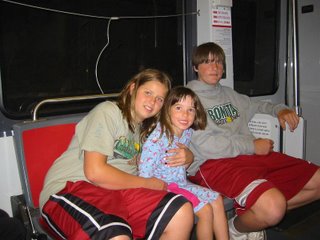
Mrs 295Bus had a doctor's appointment, and since Redwood City schools are in "fall intersession", it became an impromptu take-your-daughter-to-work day.

Fortunately we brought reading material to pass the time til our train,

and some yogurt to eat on the trip.

She got to hold the camera too:

Monday, October 23, 2006

Today's Lunchtime Outing

Today looked to be one of the last nice days of fall weather. Admittedly, I've thought that every day for a couple of weeks now, but it's still a good reason to get outside.

Today I walked around Mountain View--I walked, instead of biked, because I'm still a little dizzy from a bonk I got last night ice-skating. Generally, when I fall skating, it's forwards, which can hurt a bit, but usually I just end up polishing the ice with my shirt, like some sort of human Zamboni. Last night I tried to learn t-stops, which involves leaning backwards, and clearly I don't have it quite down yet. I wasn't in a hurry anyway, so I took a walk through the decidedly non-creepy back alleys of Mountain View.

There were a few interesting architectural oddities along the way, which I'll take pictures of sometime and post on my nkncat blog, like a rustic garage with cow skull over the door. Yee haw! Eventually I ended up at the California Street Market at California and Mariposa, and picked up a lunch that's a bit of a compromise between the yummy but not so healthy stuff I used to eat, and my current palate: one tamal, a large V8, and a banana. All very portable, so I dined al fresco and continued my tour, looped around more quaint neighborhoods, and eventually back to work.

Monday, October 16, 2006

So where ARE we Supposed to Live, Then?

The Census Bureau, in addition to counting where people live, also counts where they work. City-by-city and county-by-county results are available from their website here. You can download it in MS Excel or ASCII format. It's pretty dry stuff--just a big table of numbers--but it helps answer very un-academic questions you might be asking, like "why am I stuck driving an hour to get to work every day?", or "why am I paying so much for rent on this dump?". Last August, I wrote a bit of a rant on this subject, and accused California cities of being all too eager to attract business, but equally eager to avoid providing housing for the people who work in them. Now I've got statistics to prove it!

First, here's a useful figures on what a good ratio of employment to housing should be. Nationwide, the Census counted 281,421,906 residents, of whom 128,168,928 were enployed; that's 2.19 residents per employee. In California, the figures were 33,871,648 residents, 14,506,499 emploeyees, or 2.33 residents per employee.

So that means that cities should, on average, provide room for 2.33 residents per person they create space for the employment of. How do local cities measure up? I looked at a sample of cities starting with San Francisco, and working down the Hwy 101/CalTrain corridor. I took population and employment figures from the Census spreadsheets, figured a population need based on the employment figures times 2.33, and a housing surplus/deficit by subtracting the actual population:

CityPopulationJobsHousing
Need
Housing
Surplus/
Deficit
San Francisco776,733587,3001,368,409-591,676
Daly City103,62115,00634,96468,657
Colma1,1913,2667,610-6,419
South SF60,55241,08495,726-35,174
San Bruno40,16515,56636,2693,896
Millbrae20,7186,40214,9175,801
Burlingame28,15825,65759,781-31,623
San Mateo92,48246,512108,373-15,891
Belmont25,1237,04316,4108,713
San Carlos27,71817,85741,607-13,889
Redwood City75,40252,887123,227-47,825
Menlo Park30,78532,93076,727-45,942
Palo Alto58,59878,657183,271-124,673
East PA29,5062,7966,51522,991
Mountain View70,70859,293138,153-67,445
Los Altos27,69310,68424,8942,799
Sunnyvale131,76089,899209,465-77,705
Santa Clara102,361119,124277,559-175,198
San Jose894,943377,915880,54214,401
Campbell38,13823,14653,930-15,792
Milpitas62,69848,798113,699-51,001
Morgan Hill33,55612,86629,9783,578
Gilroy41,46415,50736,1315,333
Hollister34,4139,36421,81812,595

It's not surprising that San Francisco has a housing deficit, since its downtown has been developing as a commute destination from surrounding cities for over a hundred years now. But, whereas in times past, suburban "bedroom" communities provided enough of a "housing surplus" to offset the "housing deficit" of core cities, it's clear the peninsula and valley cities don't come close, and some--especially quintissential "Silicon Valley" cities like Palo Alto and Santa Clara, have developed into major commute targets themselves, while adding very little in the way of new housing. The result is a huge, region-wide, deficit of housing.

How big is the problem? Let's take a look at figures for the five counties that make up the urban core of the Bay Area:

CountyPopulationJobsHousing
Need
Housing
Surplus/
Deficit
Alameda1,443,741683,9571,593,620-149,879
Contra Costa948,816338,408788,491160,325
Marin247,289122,643285,758-38,469
San Francisco776,733587,3001,368,409-591,676
San Mateo707,161353,376823,366-116,205
Santa Clara1,682,585946,7562,205,941-523,356
Total5,806,3253,032,4407,065,585-1,259,260

So the Bay Area basically is short of housing to the point of needing to make room for about a million and a quarter more people. The average household in California (according to the Census Bereau again) is 2.93 people, so that works out to about a half million housing units.

If you're wondering where you can move to get away from this mess here's some figures for counties in the "greater Bay Area":

CountyPopulationJobsHousing
Need
Housing
Surplus/
Deficit
San Benito53,23415,46036,02217,212
San Joaquin563,598195,709456,002107,596
Santa Cruz255,602107,407250,2585,344
Solano394,542123,386287,489107,053
Stanislaus446,997153,956358,71788,280
Napa124,27959,875139,509-15,230
Yolo168,66086,301201,081-32,421

These figures reflect decades of bad planning and willful blindness to a growing problem. The result for most of us is choice between exhorbitant housing costs and nightmare commutes, or some "compromise" between them. As I wrote in the manifest that I opened this blog with, a solution to this problem will require leadership beyond the parochial interests of individual cities. Our state government should incent cities to provide housing proportionate to their commercial space--by whatever carrots or sticks will get the job done.

Monday, October 02, 2006

Los Ricos Tambien Lloran

Today's post is by Mrs. 295Bus.

The other day I was riding around my neighborhood on my bike with a camera. I have the (in my opinion) misfortune to live one block away from Atherton, a township with super-rich residents. The minimum size of a housing lot is one acre, and in the Bay Area, that's unusual. There's also absolutely zero commercial zoning, nor do they have a public school. I don't know how they swing that legally, but they do. I live in your typical middle class suburb; it's an immediate transition from regular folks to the likes of the CEO of Google.

So here's my bicycle tour of Atherton.

First, they have this sort of nonsense. I'm convinced it's so you can't give easy directions so it cuts down on the riff raff.

Photobucket - Video and Image Hosting

Photobucket - Video and Image Hosting

Oh look, it's greenery recycling day! They get pickup once a week in Atherton, which is a good thing, because it takes this many containers to clear those lawns of pesky leaves every week. To be fair, this is for two houses, so that's only 6-7 containers each per week. We barely fill up one container every two weeks, and we have a big oak tree in our yard.

Photobucket -   Video and Image Hosting

Then there's the creative folks, like these people, who have TV screens in their outside property wall. They turn them on at night - I've seen vacation photos, regular TV shows, and weird art shots of bloodshot eyes. Oddly, all the TV screens have been bombed by birds. Why? A mystery for the ages.

Photobucket -   Video and Image Hosting

See? It's a pretty house, except for the color. It's not really showing how putrid it looks in person in this picture. It's stucco - yellowish, greenish, brownish stucco.

Photobucket -   Video and Image Hosting

Now here's a little fixer-upper.

Photobucket -   Video and Image Hosting

You can't really see it in the picture, but the windows are broken out and it's obviously been abandoned for a long time. Gotta love the fake timber x's and all that. What would you pay for this little home improvement project?

Photobucket - Video and Image Hosting

A cool 3.9 million and it's yours. It's not like this is on the bay, or the Pacific, or even on top of a hill. There is no awesome view, it's just a big lot on a quiet street, in the "right" neighborhood.

Construction is always going on in Atherton. There's more home improvement permits issued in Atherton than there are lots. On this bike ride I passed seven of those portable taco trucks -- I counted. There's that many crews at work on any given day.

Photobucket   - Video and Image Hosting

The funny thing is you're probably thinking this is for a basement, right? Well, basements are pretty rare in California, but I have seen this more than once in Atherton. My guess is that this is for the underground garage. Probably so that the owner can house his or her classic car collection.

So a little closer to the polo fields is this little gem, which made me laugh out loud. It just looked funny to stick some cheap patio furniture in the middle of a vacant lot, but I suppose it makes sense. The realtor has to have somewhere to sit on Open House day.

Photobucket -   Video and Image Hosting

How much would you pay for this landlocked, middle-of-nothing-special lot? There's plenty of room for your 10,700 square foot dream house. You'll only have to be paying property taxes on this amount, though:

Photobucket - Video and Image Hosting

I can't diss Atherton, though, because it gives me a flat, nearly carless place to ride my bike as fast as I want. Wee!

Friday, September 22, 2006

Sorry I'm Late for Work, But...

I was busy enjoying the morning!

Nattering with my wife on the way to Menlo Park, where she swims & I catch the train.

Eating a yogurt at the station.

Drawing model railroad trackplans, in PowerPoint, on the train.

To the conductor who announced Palo Alto by singing it (terribly), and Kalifoania Ahvenue in an impersonation of Arnold Schwarzenegger: thank you!

It was a nice day for a bike ride across Sunnyvale, on the way to the bank.

It was also a nice surprise to find, in the soulless wasteland of office parks we call Silicon Valley, a hole-in-the-wall used book store, that's really cheap!

And biking parallel to the 101 on a frontage road, and easily beating everyone stuck in traffic. Ha! Server you right, you Earth-hating bastards!

Getting on the Stevens Creek Trail, not getting a flat tire, and stopping for a drink of water and a Key Lime Luna Bar (yum, and thanks, Hon!) on the Central Expwy/CalTrain/VTA overpass. Where else can you get such a good view of all the cool eletrical stuff on the roof of those light rail trains?

Picking up Tamales for lunch (to be suitably balanced with salad) at a muy autentico Mexican market in Mountain View.

Don't worry, I'll be w@h later tonight.

Wednesday, September 20, 2006

Hostes Humani Generis

Have you ever played the game Illuminati? It's a card game of comically vast conspiracies, where players construct hierarchies of front organization taking orders from secret overlords, such as the Gnomes of Zurich or the Servants of Cthulhu. But nothing in Illuminati can compare with the web of fronts and mouthpieces that ExxonMobil has created to cast doubt on the reality of global warming. Take a look at exxonsecrets.org's nifty interactive map.

It is clear by now that global warming is real, and that its effects, such as the innundation of lowlying cities, and desertification of farmland, may be catastrophic. Probably millions of lives are in the balance. This network of charlatans has slowed down honest debate about this problem for over a decade. Like pirates or torturers, they are enemies of all mankind, willing to betray their species' future for cash. They need to be called out and publicly shamed.

Years of dry academic writing leave me ill-fit for over-the-top speechifying, but I would tell them something to the effect of this speech from Roger Corman's It Conquered the World:

  This is your land, your world. Your hands are human but your mind is enemy. You're a traitor... The greatest traitor of all time. And you know why? Because you're not betraying part of mankind - you're betraying all of it.

Vote for MSR 798!

(This is the first, and hopefully only time I'm brazenly posting something on both this blog and my NKNCat blog, but dammit, this is important!)

A local (that is, S.F. Bay Area) historical preservation agency is choosing projects to fund by letting people vote for them on the internet.

I'm voting for Market Street Ry. car no 798, and encourage my fellow trolley fans to log in and do so too!

To vote, go to the Partners in Preservation website (you will have to register). 798 is listed as "San Francisco Streetcar 798" in the pulldown list ballot.

For more info on car 798, take a look at the (modern) Market Street Ry.'s website (the new MSR is a streetcar restoration group which works with San Francisco's MUNI to support the F line; they are named after the historical MSR, a former, privately-owned streetcar company, originally a competitor to the MUNI and later merged into it).

As you might guess from the checkered MUNI/MSR logos I'm using as my background on this blog, this is one of my favorite streetcars. If it wins this grant, we might all be able to take a ride on it someday soon!

Monday, September 11, 2006

Railway Safety I: Cheap and Simple Measures

Last wednesday I was home from work sick, but feeling a bit better in the afternoon, decided to go shopping with my family. From the Woodside Road overpass I noticed a few trains backed up in the Redwood Junction yard, and made a mental note that it was a good day to be out sick, since there seemed to be "trouble on the line".

The trouble turned out to be a grade crossing accident, in which an ice-cream vendor rode his tricycle ice-cream/elados cart around lowered crossing arms, and was hit and killed by a train. Typically between one and two dozen people are killed by CalTrain each year. Strictly speaking, railroad crossings are very safe. If you go when you're supposed to, you'll be fine--with considerably more certainty than you can say that about crossing a busy street. With almost no exceptions, people hit by trains either wanted to be, or were being incredibly stupid.

When these things happen, transit riders and railway boosters have a tendency to mutter cynically about Darwin awards, but these lives have value, and anyone who likes trains should be concerned with making them a safe part of the environment, even if that means protecting people from themselves. And there are reasons to pay attention to this problem beyond the purely humanitarian. First of all, let me tell you that as a passenger, these accidents can really mess up your day, both in terms of your schedule and mood. Second, we should have some sympathy for the crews that have to deal with them; consider that: an Engineer is likely to kill someone within their first year on the job, and they say that suicides often make eye contact just before impact (yikes!); conductors, on the other hand, get the job of walking the length of the train to find the victim. Finally: the perceived danger of trains is a major political obsticle to extending rail transit.

Complete grade separation is the ultimate solution to this problem, but on obscenely expensive one. If we make it a requirement for new transit projects, we run the risk of turning worthwhile simple projects into expensive boondoggles, choosing suboptimal routes to avoid expense, or killing them altogether. BART, which must be 100% grade separated because of its third-rail electrification and automatic train control, provides several good examples from recent or proposed extensions:

  • SFO: Although the line was built using an existing railroad grade, the need for grade separation meant that it was tunnelled under this right-of-way the whole difference, at a cost of $1.5 billion. The rather lower-than-predicted ridership makes this heavy investment look like a foolish one. For comparison, Los Angeles' new Orange Line busway was also built recycling an old railway right-of-way, for about a third the cost of BART's SFO extension, has about the same daily ridership, and is considered a resounding success.
  • San Jose: The cost of this line, $6 billion (the VTA and the Merc keep saying 4, but the FTA estimated 6, and I figure when it comes to public works projects, you should take the highest estimate and then add some), has just about killed it. It's not like there are any geographical barriers between Fremont and San Jose; in fact, there are already several railways between them. The expense of this project is purely due to the requirement that the line be elevated or tunnelled the entire distance.
  • Livermore: BART gets to the edge of Livermore, and ends with a station in the 580 median. It would be nice to extend it downtown, where it could connect with ACE and a few people might actually live within walking distance of the station, but locals doesn't want elevated tracks and the idea of building a subway in Livermore is just silly. Likely the line will be extended farther east, in the conveniently grade-separated but inconveniently located freeway median, competing with ACE instead of connecting with it.
I'd rather see grade separation as an incremental, long-term goal. After all, getting trains up and running without it will still improve public safety overall, by getting people away from the carnage of freeway traffic. But in the meantime, there are a lot of steps transit agencies can take to improve safety, some of which are novel ideas, and some of which are already being implemented, though in my opinion not nearly fast enough:

  • Fence right-of-ways wherever possible: As a bare minimum, people should kept away from tracks in places where there is no legitimate reason to be on them.
  • Elimenate little-used cross-streets: People can drive a few extra blocks to the next street that goes through. If it's too far to walk, build a pedestrian bridge.
  • Red-light-cameras at all crossings: Snap a picture of anyone who drives around crossing gates, and send them a hefty ticket. Repeat offenders, or anyone stupid enough to do it in a truck, should be instantly and permanently stripped of their license.
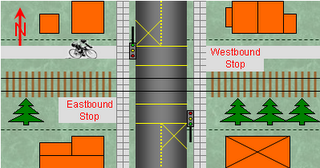
  • Near-side-stopping: Arrange platforms so that trains stop to pick up passengers before crossing a street, not after. That way they'll naturally be moving more slowly, and under better control, as they cross, to the extent that less obnoxious warning devices than the usual bells and horns might be used.
  • Use less scary vehicles: I'm not kidding. People don't seem to kill themselves by jumping in front of light rail trains, probably because they don't look as lethal. And being less threatening, they'd likely be more welcome in the community.

Near-Side Stopping

These are cheap measures that could save a few lives. Of course, as trains increase in speed and number, there comes a time where the cost of grade separation becomes necessary. Even then, there are several approaches to choose from, with different tradeoffs of cost and effect on the environment. I'll look at some of these in a future post.

Sunday, September 10, 2006

The Subtle Joys of Riding Transit

Yesterday I rode CalTrain to Mountain View and back with my daughter (yeah, I know, I do it 5 days a week already, but at least this time I had company we went to a park instead of my office). On the ride home, the back of the seat in front of us was thoroughly graffiti'ed, including this chestnut:

  I ♥ poop

As I've mentioned, my daughter is 6, and I think this may have been the highpoint of the trip for her.

Unfortunately other bits of the graffiti were gross in less child-appropriate ways, so we found another place to sit.

Monday, September 04, 2006

Raising them Right

"Trains Rule, cars drool!"

    - my daughter, 6

Wednesday, August 23, 2006

If you've been Working on your Bike and you're out of Lava Soap

How're you going to get that bike grease off your hands?

After a pleasant evening of bike maintenance I found myself in this predicament, much too late to run to the store for soap.

On a vague hunch that it would be slightly abrasive, I tried washing my hands with toothpaste.

I can report that they are thoroughly degreased, and minty fresh!

Sunday, August 20, 2006

TWAYBYB

Goddamn NIMBYs

I misremembered the train schedule the other morning, and passed some time waiting for the actual time of my train at Crêpes Café in Menlo Park (I will definitely add this place to my "where to eat" list below) with a cup of coffee and a local paper.

The top story in the Palo Alto Daily News was the organization of a new NIMBY group to fight for reduced housing in the to-be-redeveloped Alma Plaza shopping center. This comes after the P.A. city council has already convinced the developers to put in fewer housing units and more parking (you would think it was cars that vote in elections, not people).

I've seen NIMBY's in action, and it's not pretty. At a Mountain View council meeting I spoke at a few years ago on redevelopment of Mayfield/HP site at San Antonio CalTrain, they came out in force carrying signs with EIR in the universal circle-and-slash symbol for "no"--meaning that the city should refuse to do an environmental impact report, to prevent even consideration of the project--essentially, because didn't want it, no other arguments needed.

It's the same story up and down the Peninsula. Last year Redwood City voters stopped a new bayfront development that would have "sacrificed the character of the community" (the site is currently filled by a junkyard). As the no-on-Q graphic to the left makes clear--there is a breed of suburbanite NIMBY that loathes anything urban, and insists that residency gives them absolute veto rights over any development in their vicinity that does not meet their vision of suburban idyll.

And pretty much, our political system gives it to them. Zoning laws give a city's current residents control over what gets built, and no voice whatever to those who might want to live there, even if they work there, perhaps commuting long distances. And lest I bash the burbs too much, residents of cities like San Francisco and Berkeley have been just have adamant, and just as successful, in opposing development that would make them any more urban or denser.

Economic Downsides

The result is the extreme shortage of housing we now face. It's really quite striking how consistent the cities of our region are in their opposition to new housing. Where densification is allowed, it is always winnowed down, constrained and held up by years of review. The simple and sobering fact is, the Bay Area needs several million more housing units just to meet current demand, let alone allow predictable growth, but every community seems to hope that it will get built somewhere else.

It's important to remember that the high price of housing here is entirely artificial. Land, of course, is limited, and it's reasonable to expect that amenities such as large houses or yards should be expensive. But the scarcity of housing units--even ones that take up less land, like rowhouses, condos, or apartments, is simply due to cities refusal to allow more to be built.

The result is a distorted marketplace where the price of any unit is inflated. Recently, two houses on my street sold in the $700-800k range. Strangely, one was nearly twice as big as the other, and on twice as big a lot, but this didn't make that big a difference in the price--because the it's not land per se, or square footage of house that's in scarce supply--it's legally sanctioned housing units. Thus a shack on half-size lot has almost as much value as a big house on a double-sized one, even though, zoning aside, the latter could be split up into two of the former.

For a more methodical study with the same conclusions as my two-house anecdote, read here.

Remedies

The result is a form of economic discrimination which makes cities and whole regions unaffordable to ordinary, working people. It's a subtler form of exclusion than, say, burning crosses on folks' lawns, but just as effective. It also appears to be legal. Discrimination in housing, as in other areas of life, based on race, creed, etc is against civil rights laws (see, for example, this Department of Justice webpage). Discrimination based on wealth is not. Capitalism would collapse if it were.

But shelter is widely recognized as a basic human right, for example in the Universal Declaration of Human Rights. Laws that create artifical shortages of the basic necessities of life are a grave injustice. But is this an injustice that our legal system offers any remedy for?

There is at least one precedent. In New Jersey, the state supreme court has declared exlusionary zoning illegal. The original case overturned the zoning ordinances of the city of Mount Laurel Township, a suburban community which had previously allowed only suburban-style, detatched housing to be built. At the same time, the city did all it could to encourage commercial development, but made no effort to ensure sufficient housing for employees of the new businesses it attracted. The court ruled this violated the New Jersey state constitution, which gives municipalities power to control land use "for the general welfare". Exclusionary zoning violates this principle both in that is denies people their basic right to housing, and because it means a city is shirking a responsibility to the greater region to take on its fair share of population.

I can't really comment on what the long term effects of this have been on the availability of housing in New Jersey. It appears that the state's reaction to this ruling has been to create processes that allow cities to avoid lawsuits by providing nominal affordable units, but probably slow down the pace of development enough to ensure a continual shortage. (See this Wikipedia Article for discussion). The original ruling is worth a read, though, especially the opinion of Judge J. Pashman, who urged the court to go farther:

With this decision, the Court begins to cope with the dark side of municipal land use regulation -- the use of the zoning power to advance the parochial interests of the municipality at the expense of the surrounding region and to establish and perpetuate social and economic segregation...

(These practices) are inconsistent with the fundamental premise of the New Jersey zoning legislation that zoning is concerned with the physical condition of the municipality not its social condition. In a deeper sense, they are repugnant to the ideals of the pluralistic democracy which America has become...

A homogeneous community, one exhibiting almost total similarities of taste, habit, custom and behavior is culturally dead, aside from being downright boring. New and different life styles, habits and customs are the lifeblood of America.

Turning back to california, state law (search here for "housing") actually puts a very specific requirement on cities' land-use planning:

Local and state governments have a responsibility to use the powers vested in them to facilitate the improvement and development of housing to make adequate provision for the housing needs of all economic segments of the community.
a requirement which most California cities are in blatant violation of. Most make no pretense of trying to comply. The city of Laguna Niguel, which I'm only picking on because they put their zoning objectives on the web, lists as goals that they will "secure social and economic benefits for residents", "ensure adequate offstreet parking", and "protect and enhance real property values", but nothing about providing adquate housting. To the contrary, Laguna Niguel strives "to prevent undue intensity of land use or development," and "to avoid population overcrowding", or put more plainly, to keep any more people from moving there.

As someone who's knowledge of the law comes mostly from high school civics and TV (and I don't think Law & Order has done an episode about zoning yet), how cities get away with what seems to be such obvious diregard for state law is a mystery to me. No doubt, other legislation sets up a process by which a few token "affordable" units are considered satisfactory; but the spirit of the law is clear enough, as is the fact that it's being broken.

Who you can Write To

Every month, millions of Californians write rent checks, and silently fume. Citizens who suffer for the lack of affordable housing, sinking obscene portions of our income into rent or enduring marathon commutes, or both, are a huge potential consituency that politicians seem profoundly disinterested in appealing to, or eveng seeing. Then again, even the victims generally don't see this as a political issue, probably buying the line that high housing costs are the result of natural market forces, and inevitable.

Most groups and individuals advocating for affordable housing seem to share this view, at least implicitly, and favor the approach of charity, proposing that the government or non-profits should provide below-market housing to the most needy. Few seem interested in addressing the underlying causes of the problem, and there are almost no proponents of a radical anti-NIMBY, or TWAYBYB (The World Ain't Your Back Yard, Bitch!) position. Here's a few good guys I've managed to find:

If you know of others, leave a comment.

Thursday, August 17, 2006

Family Fun on BART and Muni

Monday was a day full of transit adventures.

Our basic objective was the California Academy of Sciences, where my mother is a volunteer docent. The academy, while it's usual digs in Golden Gate Park are being rebuilt from the ground up, has set up shop South of Market. The temporary location is actually quite a bit easier to get to by transit, being a quick walk from Powell & Market, or a slightly longer one from 4th & King. We set out from Millbrae BART (I advise parking on the 4th floor of the garage, since that puts you on the same level as the station mezzanine).

Meanwhile, more of our family were over in Berkely, visiting the Cal campus. The night before I worked out an itinerary for them, starting at Daily City, where they could catch a Richmond line train directly. They could have started at Millbrae, but would have needed to change trains twice--and those timed transfers at 12th St. Oakland are not something you should send BART newbies through without supervision! After the tour, we all met up downtown in the City.

We started our trip home on the J Church, stopping at Mitchell's Ice Cream (see "Where to Eat", below), and transferring back to BART at Balboa Park.

Overall, things went surprisingly smoothly. Here's some more specific observations:

  • One member of our party uses a wheelchair. BART and the Muni Metro Subway, with their high level platforms, are basically 100% accessible. You do have to go a long ways around to get to elevators at some stations. On Muni Metro surface lines, select stops have small but workable ramps and platforms squeezed into the passenger waiting islands. It takes some careful work by operators to make sure everything works, but the ones we rode with were quite conscientious about making sure we all got on and off safely.
  • BART theoretically has discount tickets for kids and seniors, but you can't buy them at stations, either from vending machines or station agents. You're supposed to get them in supermarkets. That sucks.
  • Muni was punctual, but BART slowed way down south of Balboa Park. Go figure.

Learning about rocks


Riding the J Church

Wednesday, August 09, 2006

Redwood City to Mountain View, a Practical Way by Bike

This time I tried the shortest distance between two points, my home in Redwood City and my office in Mountain View.

I've gotten off the train enough times in Palo Alto to know how about the "secret" bike bridge over San Francisquito creek, a back door connection between Menlo Park and Palo Alto. This gets you as far as the Stanford Shopping center, which you can skirt by without too much traffic, and get to fairly good bikeways through Stanford campus.

From there to Mountain View, I tried to plan a route with the VTA's online bike route map, which showed me what I had already noticed, that there's a decent bike path parallel to the CalTrain tracks (on the SW side) starting at the Palo Alto station. This connects to Park Blvd, which also Parallels the tracks, and gets you through almost, but not quite to California Street in Mountain View.

Alas, there seemed to be a disconnect where I'd have to jog over several blocks and ride on El Camino (ick). Google Maps to the rescue--on the satellite view, I could just work out that there would be some way to get through the gap, maybe by going through a parking lot.

In fact, there's a creek there, named Adobe Creek. But unmarked on any of the maps I'd seen, including the VTA's bike map there's a nice ped/bike bridge over it, connecting the gap between "Wilkie Way" and "Miller Ave".

In no time at all I was at San Antonio road, only blocks from work, but on a sudden impulse stopped at Dittmer's, a German Sandwich Shop/Deli/"Wurst-Haus" where I used to go for lunch in less health-conscious days. The aroma of tasty sandwiches was a temptation (I recommend the BLTA; "A" being for avocado), but I stuck to my mission and got a couple of cans of pickled herring. I don't know why, but a craving for pickled fish has been overtaking me lately, and this is the only place I can think of to get it. Anyway they're safely stashed in my desk for future lunches (my wife thanked me for indulging this craving at work instead of at home where she'd have to smell it...).

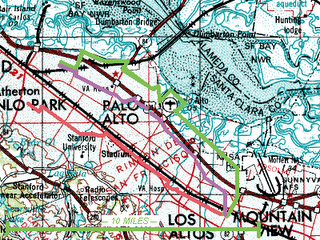
So here's my updated bike ride map, with my third route in red:

As an aside--I knew Palo Alto was posh, and I thought I knew how much, but I was wrong... this route takes you through the really nice parts, which has the advantage for biking that it's not really on the driving route to anywhere, and pretty much traffic free.

It also goes right by Fry's and Know Knew Books on Cal Ave... something to keep in mind for next time!

Tuesday, August 01, 2006

Redwood City to Mountain View, a Slightly Shorter Way

Another Tuesday, and another ice-skating playdate!

I decided to try another RWC→MV bike ride, but taking a little bit less scenic route.

I originally planned to go straight down Middlefield, but found a better route through back streets along the "inland" side of the 101.


Today's route is in purple

These are kind of interesting neighborhoods that actually still feel a little more rural than suburban; part of the way is along a creek.

Eventually I ended up in Mountain View, came over Central Expwy and the CalTrain tracks on the Shoreline Overpass (if you approach the overpass the right way, aiming to go on the East/South side of the roadway, the side facing downtown, you can find a "secret" bike path that goes through trees and tunnels and avoids the whole Shoreline/Central half cloverleaf).

Sunday, July 30, 2006

Redwood City to Mountain View, the Long Way

My usual commute is: home to Menlo Park CalTrain, by bike, approximately three miles; Menlo Partk to Mountain View, by train, 8 miles; Mountain View CalTrain to work, by bike, two blocks.

Last thursday I did something I've been talking about for a long time, and biked the whole distance. Actually, I did this about three years ago, and had some mechanical issues en route, and ended up making a slow detour to Home Depot in East Palo Alto to pick up some tools to make it the rest of the way. Having been up late wednesday catching up on deferred maintenance on my bike, and with a pretty good assortment of tools in my backpack, I set out hoping for better luck.


My Route

I actually had a bit of a head start, since my wife and daughter were going ice-skating, and I rode along with them with my bike in the van, which cut off about two miles from what I otherwise would have ridden. The rink is near the intersection of Marsh Road and the Dumbarton rail line, perhaps the site of a future station of Dumbarton Commuter Rail.


Stately Marsh Manor

A few blocks away I left the road and started pedalling down the bayfront bike trail.


Along the Bay

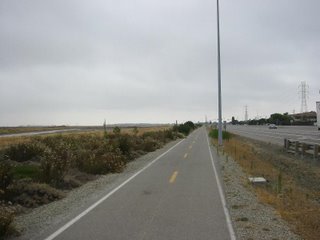
The path goes along the Salt Flats for about a mile and a half or so.


If it could rain on the moon, it might look something like this

Eventually you reach the approach to the Dumbarton Bridge, and cut through a bit of East Palo Alto. The route's not clearly marked, but eventually you can work your way through to more marshlands on the other side.


Some of the trails are paved, some are not


Some go through, others are dead ends, but at least the dead ends have nice views


Occasionally you see wildlife


Or other points of interest; this is an abandoned club house from the long-silted-up Palo Alto Yacht Harbor


A truck school was testing students on the back streets of Mountain View

Eventually the trail leads to Shoreline Park in Moutain View, where it connects with the Stevens creek trail. About this time I was starting to get hungry, and noticed a mother and kid picking blackberries. I stopped a ways down the path and followed suit. I must have ridded up a little to close to the bramble, because as I started up again, I noticed my back tire was getting a little squishy. It was a slow leak, but not too slow, and a patch kit was not one of the tools I had in my backpack. I originally planned to take the Stevens Creek trail all the way to downtown, crossing over the tracks on that cool bike bridge, but took the next exit to Moffett Drive, and hoofed it while I still had air. I started hearing the klunk-klunk-klunk that means you're really out of air and need to start walking just about as I reached the Mountain View CalTrain station, and walked the last two blocks to work.


Moffett Blimp Hangar

Thursday, July 13, 2006

Coordinating Transit: How About Starting with a Map?

Coordination between Bay Area transit agencies is pretty much non-existent. I mean, if you try transferring from one to another, even at one of the officially designated connection points (say for example CalTrain to BART at Millbrae) chances are pretty good that you'll either get off one train just in time to see the one you wanted to catch leaving, or if not it will leave while you're fumbling with change to buy your next ticket.

When it comes to Bay Area transit, it's always good advice to bring exact change and something to read.

But to me, something that really drives home how totally uncoordinated our area transit agencies are is this: you can't even get a map that shows them all. Try Google, try the official Bay Area Metropolitan Transportation Authority ("...coordinating transportation for the nine county San Francisco Bay Area") website; I defy you to find one.

Perhaps this is where the geniuses at the MTA, who seem totally incapble of coordinating schedules, or coming up with a unified ticketing system (no, TransLink is not a solution, just a kludgy workaround) might try to take their first "baby steps" towards building an actual integrated regional transit system: print a damn map of what we have now.

Wednesday, July 12, 2006

Where to Eat

So where do you go when you get hungry while you're out about on public transit. Here's a few places we've liked, or at least gone to more than once.
  • Peet's Coffee has set up shop in a lot of great transit-watching locations, such as the Ferry Building, Market between Church and Castro (watch the F line), and across the street from CalTrain in Redwood City. There are also Peets's easy walks from the Belmont and San Mateo CalTrain stations.
  • The Old Spaghetti Factory in San Jose is really only ho-hum, but it's near Diridon station and if you have some time to kill (say, for example, you're getting on a bus to L.A. at the nearby Greyhound station and it doesn't leave til 11 P.M.) downtown San Jose doesn't give you many other choices. Plus they have an old Birney streetcar inside the restaurant.
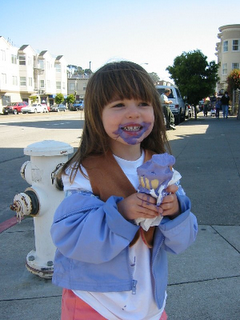
  • Mitchell's Ice Cream is just fantastic. I mean, I've seen lines out the door on rainy nights. If you want to try something exotic, get ube (which is bright purple), but really, even their vanilla is pretty damn good. It's about a block from the Muni's J Church.
  • Top Dog Hot Dogs is yummy and a block from downtown Berkely BART.
  • Fremont Wienerschnitzel; hey, Wienerschnitzels are getting hard to find these days. This one is half a block from the Fremont Centerville Amtrak/ACE station, which has a coffee shop with outdoor seating, which also happens to be closed on weekends, making it a pretty good place to eat a hot dog and watch trains.
  • Food court, Hillsdale Mall; acros El Camino from Hillsdale CalTrain (walk north from the station, past TGI Friday's, enter the mall through Sears--just crossing El Camino the most direct and obvious way kinda sucks. I recommend the hybrid Chinese/Cajun place (not kidding here).
  • Popeye's Chicken, 22nd & Mission, two blocks from 24th St. BART. I never actually made it to this one, and now I'm on a diet. Argh! Go and eat a biscuit for me.
  • Franklin St. Cafe at Redwood City CalTrain, right by the tracks.
  • Downtown San Mateo has lots of good eats within an easy walk from CalTrain. North Beach Pizza and Pizza My Heart are pretty good, but we seem to keep going back to Mr. Pizza Man.
  • Cafe Maison coffee stand at Mountain View CalTrain; many times I haven't gotten enough breakfast and picked up a croissant and a hard boiled egg for $2.00. At lunchtime the hotdogs are ok too.
  • Crêpes Café at Menlo Park CalTrain. The crêps are yummy, both savory and sweet, and the coffee's good; plus they have free wi-fi, and it's close enough to the station that you can sit on the deck until you hear the crossing bells, and still run over in plenty of time to catch your train (going southbound, anyway).
  • Cramer's Bagels; Silicon Valley is full of these Bagelwich places, usually run by Vietnamese immigrants. This one is particularly good, and happens to be in a strip mall across the street from the Santa Clara CalTrain station--where you might happen to find yourself hungry and with time to kill, if, for example, you just flew in at SJC on a weekend, when trains run hourly (take the VTA's #10 bus, which is free, from the airport to the station). Be warned the bagels are big; as I write this, I am fighting off a case of the post-lunch drowsies from eating there.
  • Indulge Asia Buffet, across the street from Belmont CalTrain. "A lot of commuter trains and SamTrans bus traffic in this corner! Makes for an enjoyable scenary while getting a bite to eat!" -- George G.
  • Yumi Yogurt across the bus circle and parking lot from Sequoia Station, Redwood City. The low calorie/carb/fat flavors are yummy and good for you!
  • MiMe's Cafe in downtown Redwood City. Actually part of a culinary arts training program for young people--who are really nice and make, imho, the best lunch in Redwood City. Sometimes you get free dessert, too!
So what are your favorites? Leave a comment and let us know!

A satisfied Mitchell's customer enjoying a cone of ube ice cream.

Friday, June 30, 2006

Simple Blogger Templates

I wanted to make my own blogger template, keeping things as simple as possible. All of the example templates I've been able to fine use cascading style sheets, which I've never really learned how to use, and just seemed kind of overdone for my tastes. Eventually, I came up with a pretty bare-bones html template, which I'm using here now. Take a look if you want to and feel free to adapt it for your own use.